Free PDF Failure to Adjust: How Americans Got Left Behind in the Global Economy (A Council on Foreign Relations Book)
This publication is offered in soft copy file that can be had by you. Reading lovers, lots of people have the analysis task in there early morning day. It is as the method to begin the day. At some point, in their noontime, they will likewise enjoy reviewing the publication. Have you started to enjoy reviewing guide? Failure To Adjust: How Americans Got Left Behind In The Global Economy (A Council On Foreign Relations Book) as one of referred publications can be your alternative to spend your time or downtime exactly. You will certainly not have to have other useless activities to open or utilize the time.
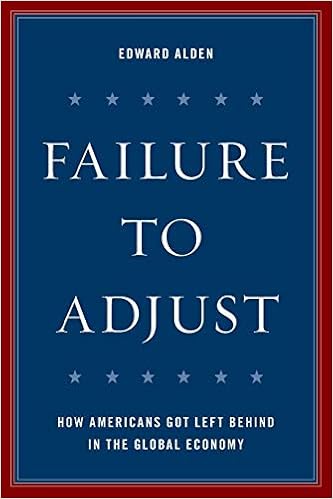
Failure to Adjust: How Americans Got Left Behind in the Global Economy (A Council on Foreign Relations Book)

Free PDF Failure to Adjust: How Americans Got Left Behind in the Global Economy (A Council on Foreign Relations Book)
After waiting on the long period of time, currently finally it comes. A book that turns into one of one of the most waited items in this period! The book that will spread around the world! Of course this book is one that we recommend for you. The most effective one as the best thing to come along with! Currently, again, the book is Failure To Adjust: How Americans Got Left Behind In The Global Economy (A Council On Foreign Relations Book)
The advantages to take for reviewing the e-books Failure To Adjust: How Americans Got Left Behind In The Global Economy (A Council On Foreign Relations Book) are coming to improve your life quality. The life top quality will certainly not simply about just how much understanding you will gain. Even you check out the fun or amusing e-books, it will certainly aid you to have boosting life high quality. Really feeling enjoyable will certainly lead you to do something perfectly. Furthermore, guide Failure To Adjust: How Americans Got Left Behind In The Global Economy (A Council On Foreign Relations Book) will certainly offer you the lesson to take as a great need to do something. You might not be pointless when reviewing this publication Failure To Adjust: How Americans Got Left Behind In The Global Economy (A Council On Foreign Relations Book)
Never ever doubt with our offer, due to the fact that we will always provide just what you need. As such as this updated book Failure To Adjust: How Americans Got Left Behind In The Global Economy (A Council On Foreign Relations Book), you might not find in the various other location. But here, it's extremely simple. Simply click and download and install, you could own the Failure To Adjust: How Americans Got Left Behind In The Global Economy (A Council On Foreign Relations Book) When simpleness will alleviate your life, why should take the difficult one? You could acquire the soft file of the book Failure To Adjust: How Americans Got Left Behind In The Global Economy (A Council On Foreign Relations Book) right here and be member of us. Besides this book Failure To Adjust: How Americans Got Left Behind In The Global Economy (A Council On Foreign Relations Book), you can likewise find hundreds listings of the books from several sources, collections, publishers, and authors in around the globe.
Also reading is an easy thing and it's very simple without spending much money, lots of people still really feel careless to obtain it. It becomes the problem that you always deal with day-to-day. Therefore, you need to start learning the best ways to invest the time very well. When it has the excellent publication, you may like to review it. As example is this Failure To Adjust: How Americans Got Left Behind In The Global Economy (A Council On Foreign Relations Book), it can be your starter publication to discover analysis.
Review
In this critical—and thorough–—analysis of US government policies regarding the country’s involvement in the global economy during the last half century, the author (Council on Foreign Relations) concentrates on the changing competitive environment the US faces. In the process of assessing the impact of those changes, he discusses a wide range of policies and how they affect US economic progress and international relations. Those policies include not only tariffs and trade agreements but also domestic tax policies, government support for enhanced investment, improvements in the education system, immigration issues, and monetary policies as they influence the international role of US currency. Part of the analysis deals with state and local governments’ attempts to take advantage of international economic opportunities in the face of insufficient federal commitments. In the process, the author also provides an insightful history of worldwide economic transformation over the last 50-plus years. This analysis is very well written and documented and is strongly recommended to anyone interested in international trade and global economic development, especially as national policy pertains to them.Summing Up: Recommended. Upper-division undergraduates through faculty. (CHOICE)Rising opposition to globalization has thrown an already polarized political environment in America into near mayhem, with our key economic partnerships hanging in the balance. Ted Alden provides a cogent and constructive analysis of the origins of opposition to economic openness that charts a viable path forward. It is essential reading for all who care about America's role in the global economy. (Gordon Hanson, Pacific Economic Cooperation Chair in International Economic Relations at UCSD and Director, Center on Global Transformation)“Ted Alden hits the nail on the head with this cogent analysis of the trade issue, its impact on American workers, our failure to meaningfully help those adversely affected and what we should now be doing to save globalization by adopting more thoughtful and far-reaching policies.” (Steven Rattner, Chairman, Willett Advisors LLC)"Ted Alden's new book, Failure to Adjust, captures vividly the inherent tension in America’s role in the post-war global economy: that between the principal architect and guardian of an open system, on the one hand, and a participant and competitor within that system, on the other. That tension cannot be removed. But in Alden’s thoughtful analysis, as the global economy grows, the balance between player and referee that needed to shift in America in favor of the former, has been late in coming. It is a really interesting and detailed assessment, that avoids overly simple diagnoses and prescriptions." (Michael Spence, Nobel Laureate and William R. Berkley Professor in Economics and Business, New York University)[Alden] demonstrates how four decades of market-friendly economic and trade policies have been insufficiently inclusive, setting the stage for the populist backlash we’re now experiencing. (Sebastian Mallaby, The Wall Street Journal)
Read more
About the Author
Edward Alden is the Bernard L. Schwartz senior fellow at the Council on Foreign Relations, and the author of The Closing of the American Border: Terrorism, Immigration and Security Since 9/11 (Harper, 2008), which was a finalist for the J. Anthony Lukas Book Prize.
Read more
Product details
Series: A Council on Foreign Relations Book
Paperback: 268 pages
Publisher: Rowman & Littlefield Publishers; Reprint edition (September 15, 2017)
Language: English
ISBN-10: 1538104792
ISBN-13: 978-1538104798
Product Dimensions:
5.9 x 0.8 x 9.1 inches
Shipping Weight: 1.3 pounds (View shipping rates and policies)
Average Customer Review:
4.8 out of 5 stars
21 customer reviews
Amazon Best Sellers Rank:
#706,336 in Books (See Top 100 in Books)
The author, Edward Alden, was the co-project director of a 2011 Independent Task Force Report on US Trade and Investment Policy sponsored by the Council on Foreign Relations. He points out that this report served as one of the foundations for his excellent new book, "Failure to Adust," so some familiarity with that report should also be helpful.The report contains a number of excellent recommendations that the Task Force made to the Obama administration in 2011, but is also worth reading because it captures the Zeitgeist that Donald Trump was able to identify and harness some four years later, which propelled him to a victorious election as our next President of the United States.For example, the Report concluded that "unless the US government can devise and implement trade and investment policies that benefit more Americans by sparking greater investment and jobs in the US linked to the global economy, it will be impossible to rebuild public support for trade policy. In other words, it was not enough to say that globalization would lead to a larger pie; a growing number of Americans were asking "Where is my slice?"It also concluded that the primary reason for the stalling of US trade policy is the serious employment and income pressures so many Americans face. Many have dismissed the extent to which globalization has contributed to these employment and income pressures, pointing to the fact that technology--including, for example, automation--has also led to job losses and downward pressures.But, in "Failure to Adjust" Edward Alden, citing a 2013 NBER working paper titled "Untangling Trade and Technology," points out that "import competition and technology have quite different impacts on the US workforce; while technology and trade are both disruptive, import competition has a much bigger impact on labor markets. Those who lose their jobs to computers are likely to find new ones, while those who lose their jobs to imports are much less likely to do so." He explains that "if companies invested in machinery that required fewer workers, or if new technologies made some jobs obsolete, then those workers would not likely find jobs doing the same type of work they had done previously. But if the companies reinvested their profits domestically, other sorts of jobs would be created that would at least partly compensate. ...In a more global market, however, the circle could be less virtuous."This is just the tip of the iceberg, but building upon insights such as this is what make the analysis and recommendations that follow to be so compelling. (It should be noted that while Donald Trump was able to tap into the right wing populist sentiment that emanated largely from globalization, President-elect Trump's policy prescriptions may not bear any resemblance to the domestic and international trade & investment policies found in this book.)
The US is a market economy. Its society believes in the principles of free trade and competition. But, a lack of a cohesive trade and competitiveness policy is very naive.Government intervention is required in those cases were temporary market dislocations and competing countries' unfair practices create havoc to American employees and communities.Both Republican and Democratic presidents have stand against foreign competitors that don't abide by fair rules, or that simply manipulate their currencies to make their exports more competitive.The emergence of an indigenous trade policy has been spearheaded by the country's states, which for the lack of Federal strategy, have created their on independent strategies to attract foreign investment.
Another fantastic book by Edward Alden. As with his previous works, he focuses in on the right question and issue: not whether trade is good or bad for the American economy (the wrong/politicized question that dominated this year's presidential campaign) -- but how the overall forces of globalization overall have impacted it. More importantly, he charts a pragmatic -- and attractive -- path forward. A must read for anyone who cares about American competitiveness.
Excellent discussion of the subject. This is not the typical simplistic there-is-only-one-problem-and-here-is-the-solution type of book. The author investigates many reasons for the US problems with globalization: Federal government trade policy, international currency manipulation and the US political obsession with a "strong dollar," offshoring, US trade adjustment assistance programs (more accurately the lack of them), a failing public educational system, tax policy, and other issues.
Failure to Adjust is particularly timely in light of the recent election and the rise of populist anti-trade movements that have been overtaking the United States and Western Europe. The book provides great background on the post-World War II conditions that made American manufacturing conditions so favorable, and creates a compelling framework on how to move forward through redesigning the corporate tax system, fostering innovation, and promoting education to reinvigorate labor. Alden’s recommendations are particularly insightful when it comes to considering how the United States can set the rules for international trade, balancing its role as a bastion of free-market capitalism with keeping its own economy competitive without resorting to highly ineffective protectionist measures that only provide short-term solutions to American job losses. Great read!
Fairly complete but slanted away from one of the biggest cause of the current crises in the United States and the world, the overwhelming power of the largest world corporations, their influence of U.S. and world politics, their manipulation of markets for their own profit, and their lack of concern for human rights. While Alden mentions many of these corporations and their actions, he puts little emphasis on them. Also he mentions China but doesn't mention their One Belt One Road project that is beginning to have very important world effects, mostly beneficial
This book is a history of US trade policy from end-WWII to the present. It clearly outlines the main reasons for the U.S. trade deficit, weakness in the manufacturing sector, loss of manufacturing jobs.
Excellent historical analysis of last global economic regime and outstanding assessment of global competitive current scenario driving actual political movements around the world
Failure to Adjust: How Americans Got Left Behind in the Global Economy (A Council on Foreign Relations Book) PDF
Failure to Adjust: How Americans Got Left Behind in the Global Economy (A Council on Foreign Relations Book) EPub
Failure to Adjust: How Americans Got Left Behind in the Global Economy (A Council on Foreign Relations Book) Doc
Failure to Adjust: How Americans Got Left Behind in the Global Economy (A Council on Foreign Relations Book) iBooks
Failure to Adjust: How Americans Got Left Behind in the Global Economy (A Council on Foreign Relations Book) rtf
Failure to Adjust: How Americans Got Left Behind in the Global Economy (A Council on Foreign Relations Book) Mobipocket
Failure to Adjust: How Americans Got Left Behind in the Global Economy (A Council on Foreign Relations Book) Kindle
COMMENTS