Download PDF King Of Fish: The Thousand-Year Run of Salmon
When some people believe that this is a hard book to read, we will inform you that it becomes one of the smarter suggestions to find with something different. The various things of the King Of Fish: The Thousand-Year Run Of Salmon with other books are lasting heading how the writer improvisate and pick the subject frequently as well as remarkably. It will be timeless as well as countless making all people really feel decorated and amazed of this publication.
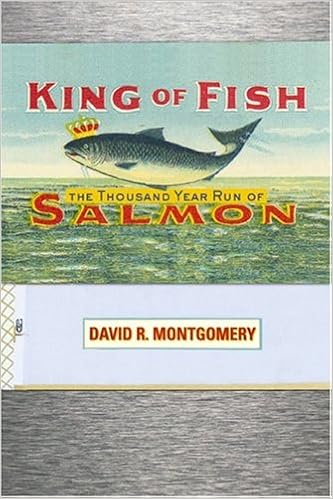
King Of Fish: The Thousand-Year Run of Salmon

Download PDF King Of Fish: The Thousand-Year Run of Salmon
The supreme sales letter will provide you a distinct publication to overcome you life to a lot higher. Schedule, as one of the reference to get several resources can be thought about as one that will certainly link the life to the experience to the understanding. By having book to read, you have actually aimed to connect your life to be much better. It will certainly motivate your quality not just for your life however also people around you.
When reading the title, you can see how the author is very reliable in using the words to create sentences. It will be also the ways how the author creates the diction to influence many people. But, it's not nonsense, it is something. Something that will lead you is thought to be better. Something that will make your feel so better. And something that will give you new things. This is it, the King Of Fish: The Thousand-Year Run Of Salmon
Look and look shelves by shelves to locate this book. But at some point, it will be nonsense. As a result of this problem, we currently supply the great deal to develop the brief way to acquire guides from numerous resources get in double-quick times. By this way, it will really reduce you making King Of Fish: The Thousand-Year Run Of Salmon so all set to gain in double-quick time. When you have actually done and also acquired this book, it is much better for you to quickly start reading. It will lead you to get the disciplines and also lessons rapidly.
To check out King Of Fish: The Thousand-Year Run Of Salmon, you could refrain challenging methods. In this age, the supplied internet book is below. Seeing this web page ends up being the starter for you to find this publication. Why? We provide this kind of publication in the listing, amongst the hundreds of book collections to locate. In this page, you will discover the link of this publication to download and install. You could follow up guide because web link. So, when you really require this book immediately, subsequent just what we have informed for you right here.
From Publishers Weekly
Drawing on a combination of scientific, historical, sociological and political research, Montgomery, a professor of geomorphology at the University of Washington, traces the tragic and steady decline in salmon populations in Europe, New England, Eastern Canada and the Pacific Northwest. Using his detailed analysis of the destruction of native salmon runs at each site, Montgomery demonstrates that the decline has been caused by the same four actions: polluting rivers in the name of technology, changing the natural environment by damming rivers and clear-cutting forests, overfishing, and ignoring regulations and laws imposed to help salmon populations recover. Montgomery's history of salmon moves from awe inspiring (their ancestors go back some 40 million years) to heartbreaking ("Lonesome Larry was the only sockeye [salmon] that made it back [to Redfish Lake] in 1992"). But when the book's focus changes from fish to the likes of Queen Anne, King George, Richard Nixon and Gerald Ford, who were all unsuccessful in stopping the salmon's slide toward extinction, Montgomery's tone becomes decidedly bleaker. Though the nature of the salmon's struggle to survive against these recurring threats to its life and habitat causes the book to be somewhat repetitive, Montgomery saves his best writing for the last chapter, where he courageously outlines the scientific evidence surrounding the salmon's plight and presents a no-nonsense plan for the fish's tenuous hope for survival. Photos and maps not seen by PW. Copyright 2003 Reed Business Information, Inc.
Read more
About the Author
David R. Montgomery is Professor of Geomorphology at the University of Washington. His research focuses on landscape evolution, including the impact of erosion and sedimentation on biological systems. A member of advisory committees to governmental bodies and private organizations dedicated to protecting rivers and wildlife, Montgomery lives in Seattle with his wife Anne, and his field assistant Xena, a black lab-chow mix.
Read more
Product details
Hardcover: 304 pages
Publisher: Basic Books; 1st Edition. edition (October 8, 2003)
Language: English
ISBN-10: 0813341477
ISBN-13: 978-0813341477
Product Dimensions:
6 x 0.8 x 9 inches
Shipping Weight: 1.2 pounds (View shipping rates and policies)
Average Customer Review:
4.6 out of 5 stars
26 customer reviews
Amazon Best Sellers Rank:
#706,458 in Books (See Top 100 in Books)
In King of Fish: The Thousand-Year Run of Salmon, author David Montgomery analyzes the decline, in many cases the near extirpation, of once-abundant salmon fisheries in Great Britain and northern Europe, in New England and Canada, and in the Pacific Northwest. First published in 2003, the book is still fresh and relevant, an engrossing read, chock full of information, and ending with practical insights and a call to action.The key theme of King of Fish, which the author thoroughly documents, is that the historic decline of salmon stocks has not occurred because people didn’t know any better or because they just didn’t care. Instead, the depredation of the fishery happened despite the best efforts of thoughtful people and bodies politic to protect and preserve them. How could this be?When fisheries management and conservation have clashed with financial interests in development and exploitation, the salmon have consistently lost – not every single time, but often enough that the incremental and inexorable accumulation of individual short-term decisions has eroded and whittled away salmon populations and habitats to the point that they collapsed.Montgomery demonstrates through numerous examples that you can literally bank on the economic value of fish harvest or hydropower or irrigation or any number of other ephemeral interests to outweigh the uncertainties and risk-based arguments on the other side.There is a systemic imbalance in these interests that all but guarantees that the fish will lose whenever decision making is left to local interests. There are only two notable exceptions: pre-industrial Britain, when royal authority provided a respite from overfishing, and Alaska, where federal regulation has provided a significant measure of protection for salmon interests.Montgomery sums it up neatly: “One of the most obvious lessons of past experience is that local control rarely protects salmon over the long run without direction from a higher authority, whether the king, a federal agency, or, as for Native Americans, the Creator through deeply ingrained cultural practices.†(230) That is the lesson taught by the global history of salmon. Will we learn from it?The King of Fish is just as informative and thought provoking today as when it was first published. And its core lesson that laws and regulations, and centralized authority to back them up, are needed to restrain unfettered exploitation of natural resources, has applications far beyond salmon. It is the story of conservation writ large, with obvious analogies to effective public policy on climate change, fracking, wilderness preservation and a host of similar issues.
Great, accessible history and analysis of British and North American human interaction with salmon. In many ways the story is an excellent puzzle piece, connecting various other historical narratives spanning time from the Middle Ages through present with a focus on post 18th century events. The book is not a about pointing fingers but rather about understanding the decisions and actions that have led to the current state of salmon fishing and lay out options for the future. While it lagged a bit for me in the middle, it is pretty short and the beginning and end move rather quickly. While not prize winning prose, the author makes a discernible attempt (successfully) to liven up what could otherwise have been a dry timeline of legislative history and interpretation of social factors affecting salmon fishing.
This was a fascinating book on the history of salmon. It is the age old story of history repeating itself. I had no idea that Europe's rivers were full of salmon throughout the centuries until misuse and neglect of the rivers, as well as overfishing, destroyed most of the runs. Same story on the east and west coast of the United States. Overfishing on the high seas is addressed to some extent. Salmon history in Alaska is still being written, so information is limited in the book, but from what I've seen, we have not yet learned our lesson. Not being of a scientific mind, for me the book got a little tedious towards the end, but still a great book with valuable information.
Read this book with fellow Whale Scouts (volunteer naturalists facilitating land-based whale watching and doing habitat restoration). His writing was beautifully researched and well crafted, making what could have been just dry data, a compelling story. It impressed on me how history repeats itself, and unless we heed the lessons, we're on course to drive wild salmon, once plentiful here in the Pacific Northwest, to extinction.
Interesting book if you’re a fish person. Having spent years in the Alaska fishing industry I found it to be a very interesting and informative read.
If you have any interest at all in the preservation of salmon, this book is a must-read. The history of our abuse of this magnificent family of fish is more than scary. Read this and take action!
well written description of why we NW Salmon stocks are deteriorating. Looking through the lens of this book being written in 2003 it is proving to be accurate.
Easy to read. A history book. Gives you a flavor of the debate. Cons: biased. Does not tell you that salmon stocks are resilient, if you give them a chance. Filters the positive. For example, that hatcherys are not all bad, though it's true historically they started out as a way to supplement commercial fisheries. For example, that roughly as many salmon stock (a river by river analysis) surveyed in Alaska are increasing as are declining (about 6% each) while the rest is stable. True, that is Alaska and the book is primarily about the Pacific NW, with digressions about Atlantic salmon and the salmon formerly found in Europe.Prose is well done, conversational. Perhaps a bit of the author's ego can be seen when he talks about his interaction with his beloved dog a lot. But this is not a dry, scientific tome,and most readers are better for it.You can also get hard info on salmon off the web, just by searching the web, but this book packages this info, filters it somewhat to give a weepy, sad conclusion, and is more interesting to read than a dry report. Book has an excellent illustrated family tree of Salmon too, which is worth the price of the book.Recommended as a dreary but not entirely inaccurate portrait of salmon.
King Of Fish: The Thousand-Year Run of Salmon PDF
King Of Fish: The Thousand-Year Run of Salmon EPub
King Of Fish: The Thousand-Year Run of Salmon Doc
King Of Fish: The Thousand-Year Run of Salmon iBooks
King Of Fish: The Thousand-Year Run of Salmon rtf
King Of Fish: The Thousand-Year Run of Salmon Mobipocket
King Of Fish: The Thousand-Year Run of Salmon Kindle
COMMENTS